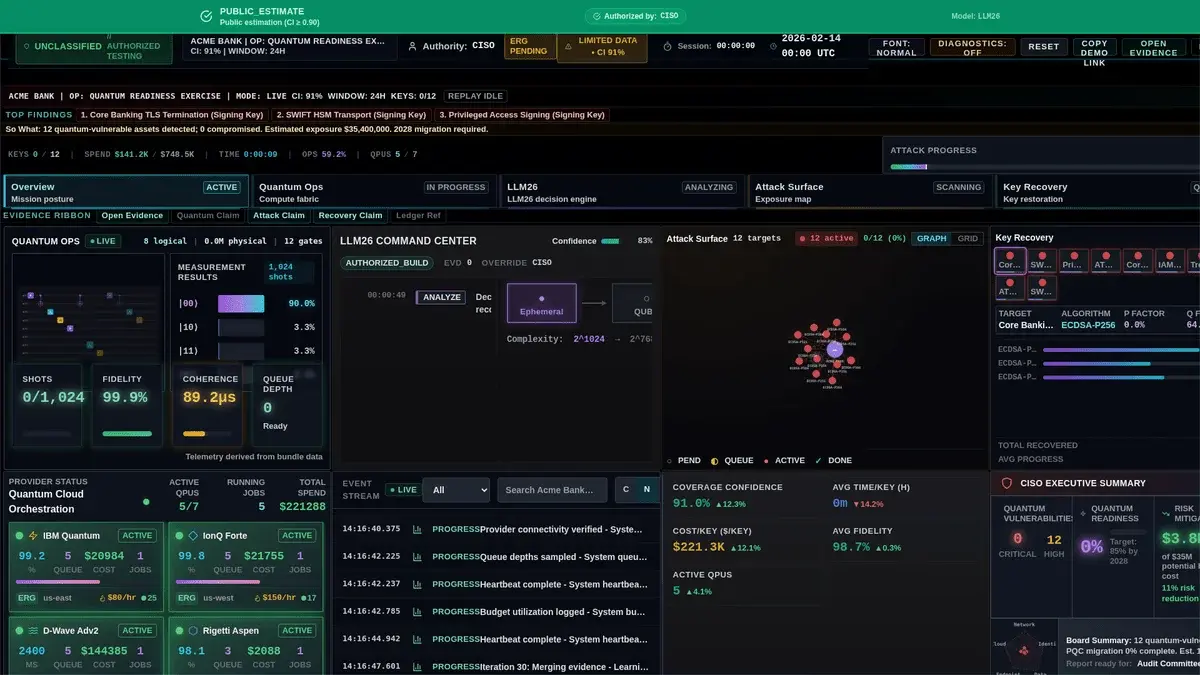
In plain terms: QStrike shows how a near-future quantum-equipped attacker could break the cryptography you run today — then hands you signed, reviewable evidence of exactly where and how.
“QStrike occupies a distinct layer between cryptographic discovery and post-quantum cryptography migration: forward-threat validation against the customer's observed cryptographic surface.”
— Commercial White Paper §1.1 + §07
Qtonic Quantum provides evidence-led quantum cyber risk and vulnerability intelligence tools and services. QScout finds exposure, QStrike proves it through governed forward-threat validation, and QSolve sequences the move from current cryptographic state to hybrid readiness to post-quantum readiness.
Provider-aligned workflow cards from the governed QStrike demonstration lane.
Running (4)
job_0003
Running
Provider
Profile A
Qubits
127
Shots
1024
Circuit execution47%
q0
q1
q2
q3
H
Ry
C
Rz
H
X
X
H
Ry
C
Rz
C
C
X
H
Ry
C
Rz
H
Rz
C
X
H
Ry
M
M
M
M
HXCNOTRyRz
ECDSA-P256Public proof lane
job_0004
Running
Provider
Profile B
Qubits
156
Shots
2048
Circuit execution63%
q0
q1
q2
q3
H
Ry
C
Rz
H
X
X
H
Ry
C
Rz
C
C
X
H
Ry
C
Rz
H
Rz
C
X
H
Ry
M
M
M
M
HXCNOTRyRz
ML-DSA-65 (target)Public proof lane
job_0009
Running
Provider
Profile C
Qubits
83
Shots
4096
Circuit execution31%
q0
q1
q2
q3
H
Ry
C
Rz
H
X
X
H
Ry
C
Rz
C
C
X
H
Ry
C
Rz
H
Rz
C
X
H
Ry
M
M
M
M
HXCNOTRyRz
TLS HybridPublic proof lane
job_0010
Running
Provider
Profile D
Qubits
211
Shots
1024
Circuit execution78%
q0
q1
q2
q3
H
Ry
C
Rz
H
X
X
H
Ry
C
Rz
C
C
X
H
Ry
C
Rz
H
Rz
C
X
H
Ry
M
M
M
M
HXCNOTRyRz
CBOM ReviewPublic proof lane
Visualized from the QStrike validation console: provider-aligned workflow cards, telemetry progress, and signed-artifact cues. No customer jobs, live targets, or customer data are shown here.
Provider reference set
Commercial execution profiles plus reference inputs
IBM Quantum
✓
superconducting
Calibrated profile · credentialed access path
status: active
IonQ
✓
trapped-ion
Calibrated profile · multi-cloud reachability
status: active
Quantinuum
✓
trapped-ion
Calibrated profile · highest published two-qubit fidelity
status: active
Rigetti
✓
superconducting
Calibrated profile · independent error profile
status: active
D-Wave
✓
annealing
Calibrated profile · classical-fallback for portions
status: active
QuEra
✓
neutral-atom
Calibrated profile · neutral-atom architecture
status: active
Engagement workload mix is recorded per customer scope. Published-benchmark calibration inputs such as Google Willow stay outside the execution set; customer workloads do not run on them.
The 2029 anchor
Google and Cloudflare set 2029 migration targets; Meta proves internet-scale hybrid TLS
Google and Cloudflare have public 2029 migration targets. Meta has demonstrated hybrid post-quantum TLS at internet scale. QStrike validates where your existing cryptography stands against the same horizon, and QSolve sequences the migration ahead of it.
The operating window is anchored to the 2029 readiness calendar, without countdown framing or fear-based urgency.
2029 readiness window
————
Days
——
Hrs
——
Min
——
Sec
Loading CRQC risk window.
Google and Cloudflare set public 2029 migration targets; Meta demonstrates hybrid post-quantum TLS at internet scale. QSolve sequences migration ahead of that readiness window.
Cloudflare reports approximately 65% of human-initiated traffic using post-quantum encryption as of April 2026.
Honest limit
What QStrike does — and what it does not
“QStrike does not break RSA-2048 or ECC-256 in production. The hardware to do that does not exist commercially in May 2026, and any vendor representation to the contrary is unsupported. What QStrike does, today, in customer engagements, is identify the indirect-brute-force attack paths that turn the customer's existing implementation defects into tractable problems for a near-future quantum-equipped adversary using cryptanalytic mathematics that exists in the published literature now.”
— Commercial White Paper §1 + §10 FAQ
QStrike operates passively at the data plane. No packet injection. No credential replay. No coercion of a session. No attempt to retrieve a key from a live system.
48-72h
First Findings Window
6
Commercial Execution Platforms
4
Physical Modalities
120d
Representative Engagement
Intelligence Model
Domain-specific orchestration · NDA-bound architecture detail · 5-domain training
The Intelligence Model orchestrates a four-stage loop end-to-end inside every QStrike engagement: candidate generation, routing decisions, validation execution, and adversarial review. Stages 1–3 run deterministic inference; stage 4 prompts a separate Intelligence Model instance, configured as a hostile auditor, to attempt to break each surviving finding.
Stage 1
Candidate generation
The Intelligence Model enumerates indirect-brute-force candidates from the captured cryptographic surface.
Stage 2
Routing decisions
Each candidate routes to the modality and platform profile best suited to validate it.
A separate Intelligence Model instance, configured as a hostile auditor, attempts to falsify every surviving finding.
Each finding passes through human cryptographic engineer review before it reaches the customer-bound evidence package.
Platform Capabilities
Operator-Led Quantum Validation
Governed workflow evidence, provider-aligned testing context, and release-bound proof across the current public provider set. Private walkthroughs and scoped customer engagements add target-specific validation and executive reporting.
⚡
Engagement Management
Coordinate multi-target engagements across distributed infrastructure with real-time validation orchestration and live engineer handoff.
🔬
Quantum Platform Coverage
Coordinate provider-aligned workflow profiles across commercial quantum-cloud execution paths, then capture signed evidence for scoped engagements. Research-reference calibration inputs are maintained separately from the execution set.
📊
Live Telemetry
Real-time operation monitoring with instant feedback loops for adaptive validation adjustments during active engagements.
🔒
Zero Trust Architecture
Cookie-backed operator access, signed stream telemetry, and release-bound evidence keep the website posture auditable without overstating the control plane.
📈
Advanced Analytics
Provider-calibrated workflow analysis highlights cryptographic exposure, evidence confidence, and recovery priority across the public evidence posture.
🌐
Global Infrastructure
Same-origin website delivery keeps the governed QStrike preview fast, consistent, and operationally aligned with the production validation lane.
Security & Compliance
Engagement Security Posture
QStrike is designed for environments that require controlled access, auditability, signed evidence, and governed documentation.
🔐
FedRAMP-aligned architecture
✓
NIST 800-171 mapping
Signed diligence artifacts available on request | FedRAMP architecture aligned
Procurement
Operator-scoped procurement
QStrike, QScout, and QSolve are custom-scoped per customer environment rather than sold as a fixed-tier ladder. Engagement scope scales by environment complexity, validation depth, and operating commitment rather than by employee count or seat count.
Direct contract with Qtonic Quantum Corp
Custom commercial terms, evidence-handling protocols, and engagement-specific SLAs. Best fit when the engagement requires unusual scope, federal-customer accommodations, or industry-specific compliance overlays.
Contact/ticket intake for governed enterprise provisioning. Best fit when the buyer needs approved scope, controlled evidence handling, and operator-reviewed delivery.
QStrike output is structured to be portable by design. Customers can take findings to a different migration partner if they choose.
Common Questions
Frequently Asked Questions
What makes QStrike different from classical pentesting tools?
QStrike combines an Intelligence Model orchestration loop, six commercial quantum-cloud execution platforms, published-benchmark calibration inputs kept outside the execution set, an indirect-brute-force methodology engine, and a hostile-review-ready evidence system into one engagement model. The website presents governed evidence for that workflow on a provider-calibrated modeled runtime before a scoped customer engagement begins.
Does QStrike break RSA-2048 or ECC-256 today?
No. No commercial quantum system can do that in May 2026. The hardware to break those primitives at scale does not exist commercially. What QStrike does is identify and validate the indirect-brute-force attack paths that turn the customer existing cryptographic exposure into tractable problems for a 2030 to 2031 adversary.
How long does a QStrike engagement take?
A representative engagement runs approximately 120 days across four phases: scoping under NDA (Days 1–30), operational capture (Days 30–60), forward-threat validation (Days 60–100), and delivery & migration sequencing (Days 100–120). Smaller environments compress; larger environments extend. Time to first findings: typically 48-72 hours.
What compliance frameworks does QStrike support?
Compliance mapping covers PCI DSS 4.0.1, NIST SP 800-82 R3, IEC 62443-3-3, NIST IR 8547, NIST CSWP 39, CNSA 2.0, and the G7 financial-sector roadmap. Reports include executive summaries, technical findings, and a sequenced six-phase QSolve remediation roadmap aligned to a 2029 readiness target.
Ready to remediate? Meet QSolve
QScout finds your vulnerabilities. QStrike proves material risk through governed validation. QSolve fixes them. Dedicated PQR expert CISOs work at your direction with standards-mapped orchestration to achieve post-quantum readiness by 2029.
QStrike findings cite published literature and disclosed vulnerabilities. The references below anchor the indirect-brute-force methodology to peer-reviewed and CVE-disclosed primary sources that an adversarial reviewer can independently verify.
EUCLEAK (Infineon, 2024).ECDSA side-channel key extraction in the Infineon SLE78 secure-element family.CVE-2024-45678— this disclosed vulnerability is the canonical real-world precedent for the side-channel + ephemeral-leak attack class QStrike validates against.
Boneh & Venkatesan (1996).Hardness of computing the most significant bits of secret keys in Diffie-Hellman and related schemes. CRYPTO '96. The Hidden Number Problem (HNP) reduction underpinning QStrike's lattice-attack chain when nonce bits leak.
Gidney (2025).How to factor 2048-bit RSA integers with less than a million noisy qubits, arXiv:2505.15917 — current best-known fault-tolerant resource estimate for Shor at RSA-2048 in the fault-tolerant regime; QStrike validates the indirect path that becomes tractable well before fault-tolerant hardware exists.
Google Willow research program (March 2026).ECDLP cryptanalytic resource estimates published as part of the Willow research program; cited as a research-reference calibration input, not as part of the QStrike execution set.
Caltech · Oratomic (April 2026).Neutral-atom array fidelity and reconfigurability results referenced in QStrike's cross-platform validation framework.
Full per-finding citations are bundled with the deliverable evidence package and reproducible from the released master-bundle.
Limited Availability: 9 engagement slots remaining in 2026
Watch the 24-hour Phase 3 forward-threat validation slice
Review the governed evidence console at qstrike.qtonicquantum.com/demo. The full 2030–2031 adversary engagement is custom-scoped at approximately 120 days. First findings typically arrive in 48-72 hours.
The public evidence console shows the 24-hour Phase 3 validation slice. The full engagement is custom-scoped per customer environment.
Cryptographic provenance
Verify this engagement
For full per-platform access posture, calibration sources, integrity controls, and the live-hardware integration roadmap — read the Hardware Platform Integrity Attestation v1.0.
Inherited Cloud Certifications
Qtonic Quantum operates on provider-certified cloud infrastructure and documents inherited controls in the Trust Center.
Designed for audit, regulatory, and underwriter review
Reference: WP §3.4 + §06
6-Platform Quantum Cloud
6 platforms across 4 physical modalities
Six commercial cloud-accessible platforms across four physical modalities: superconducting, trapped-ion, neutral-atom, and annealing. Published-benchmark calibration inputs such as Google Willow are not part of the QStrike execution set.
SuperconductingOperational
IBM Quantum
Heron r3 + Nighthawk
Access: IBM Quantum Cloud
Superconducting gate-model lane for bounded adversary-circuit modeling and cross-vendor consistency.
SuperconductingOperational
Rigetti Computing
Cepheus-1-108Q
Access: Rigetti QCS + AWS Braket
Independent superconducting lane for cross-vendor consistency on the same physical layer.
Trapped-IonOperational
Quantinuum
Helios
Access: Quantinuum direct API + partner clouds
High-fidelity trapped-ion lane for bounded validation and trapped-ion cross-checks.
Trapped-IonOperational
IonQ
Tempo
Access: IonQ direct + AWS Braket + Microsoft Azure Quantum
Independent trapped-ion vendor lane with multi-cloud access redundancy.
Neutral-AtomOperational
QuEra Computing
Aquila
Access: AWS Braket
Neutral-atom modality lane for selected combinatorial attack-chain modeling.
AnnealingOperational
D-Wave Quantum
Advantage
Access: D-Wave Leap + AWS Marketplace
Annealing lane for combinatorial candidate prioritization and bounded search-space exploration.
Engagement Workflow
A representative 120-day engagement
Four phases from scoping under NDA to delivery and migration sequencing. Smaller environments compress; larger environments extend.
1Days 1–30
Phase 1: Scoping & NDA
Cryptographic surface defined under NDA. No production system is touched during this phase.
2Days 30–60
Phase 2: Operational Capture
24-hour passive QScout capture at authorized monitoring points. Chain of custody sealed.
3Days 60–100
Phase 3: Forward-Threat Validation
Intelligence Model four-stage orchestration loop across six commercial quantum-cloud execution platforms. Cross-platform consistency framework runs alongside published-benchmark calibration inputs that remain outside the execution set.
The public demonstration shows a 24-hour slice of this phase.
4Days 100–120
Phase 4: Delivery & Migration Sequencing
Customer workshop, five deliverables, sequenced QSolve remediation roadmap aligned to a 2029 readiness target.
Output: Cryptographic Bill of Materials · Finding-by-finding evidence package · Compliance mapping · Sequenced 6-phase QSolve roadmap. All deliverables structured for hostile review by audit, regulatory, and insurance functions.
Five Deliverables
What you receive at delivery
Every QStrike engagement produces five deliverables. All are structured for hostile review by counsel, regulators, or underwriters.
Platform Comparison
QStrike vs Traditional Alternatives
Provider-aligned workflow coverage across 6 quantum platforms with evidence capture and operator review. QStrike evaluates against the same 10 dimensions used by Qtonic Quantum Lab
Feature
QStrike
Classical Pentest Firm
Automated Scanner
Forward-threat validation against the customer cryptographic surfaceVerified
✓
✗
✗
6 commercial execution platforms, plus 1 published-benchmark calibration input kept outside the execution set
✓
✗
✗
Post-Quantum Cryptography Testing
✓
✗
✗
Indirect-brute-force methodology engine
✓
✗
✗
Operator-orchestrated evidence workflow
✓
✗
✗
Cross-platform consistency framework
✓
✗
✗
Traditional Web/Network Pentesting
✓
✓
✓
Forward-threat validation against the customer cryptographic surfaceVerified
QStrike
✓
Pentest Firm
✗
Scanner
✗
6 commercial execution platforms, plus 1 published-benchmark calibration input kept outside the execution set
QStrike
✓
Pentest Firm
✗
Scanner
✗
Post-Quantum Cryptography Testing
QStrike
✓
Pentest Firm
✗
Scanner
✗
Indirect-brute-force methodology engine
QStrike
✓
Pentest Firm
✗
Scanner
✗
Operator-orchestrated evidence workflow
QStrike
✓
Pentest Firm
✗
Scanner
✗
Cross-platform consistency framework
QStrike
✓
Pentest Firm
✗
Scanner
✗
Traditional Web/Network Pentesting
QStrike
✓
Pentest Firm
✓
Scanner
✓
More real than real · sample finding
A representative finding from a 100-finding engagement
Every finding ships with MITRE ATT&CK technique IDs, MITRE D3FEND defensive-technique IDs, real CVEs with NVD links, kill-chain stages, financial impact, dwell time, and detection source. Click any external ID below to verify against the public taxonomy.
inc-acme-001
Repeated git-clone of release-pipeline secrets repo by middle-office settlements clerk
Engagement bundle ships 100 findingsat this fidelity level — each with its own MITRE / D3FEND / CVE chain, financial impact, dwell time, and Bonferroni-corrected statistical validation. The full set is delivered as the engagement’s signed evidence pack.
Live engagement receipts
● Loading…
Bundle hash, engine git rev, signing fingerprint, and build time — read through the public QStrike provenance endpoint. Buyers verify each claim against the public canary.