Post-Quantum Has 13 Dated Deadlines. The First Came Due October 22.
Every date checked at its source. The first filings rest on inventories GAO could not fully substantiate. Three more reach suppliers by March.
On October 15, Technology.org published the most careful post-quantum deadline map we have seen in general circulation. Alius Noreika went to the primary documents, caught the 90-day versus 120-day confusion that trips most summaries, and correctly scoped the 2030 and 2031 dates in Executive Order 14412 to high-value assets and high impact systems rather than every federal computer [1]. We checked every date in it against the source texts. We found no errors. That is rare enough to say out loud.
We agree with the map. We disagree with its last line, which says the October 22 filings change little outside Washington. They change a great deal, for two reasons the deadline pieces have not connected. The first is what those filings are built on. The second is which of the thirteen dates actually reaches a company that is not a federal agency, and how soon.
The Map
The calendar has thirteen dated entries once you lay the US, NSA and EU instruments side by side [2][3][4][5][6]. Six are binding today. Two are proposed rules with publication deadlines set by executive order, and a third row carries the compliance date that rule would impose. One is NIST IR 8547, which set the industry's planning horizon as a draft from November 2024 and became final on October 27, 2026. Two are agreements between EU governments that are not yet law, and the 2035 line gathers all of the above.
THE MAP
Thirteen Dated Deadlines. Six Are Binding Today.
| Date | Instrument | Who it binds | What is due | Status |
|---|---|---|---|---|
| Oct 22, 2026 | OMB M-26-15 | Federal civilian agencies | PQC migration plan to OMB and ONCD, with a third-party coordination plan | Binding, due date passed |
| Dec 19, 2026 | EO 14412 Sec. 6(c) | FAR Council | Proposed rule for covered contractors published | Pending |
| Dec 31, 2026 | EU coordinated roadmap | EU member states | PQC roadmap defined in each member state, planning underway | Agreed, not law |
| Jan 1, 2027 | CNSSP 15 / CNSA 2.0 | New NSS acquisitions | CNSA 2.0 algorithms required | Binding |
| Mar 19, 2027 | EO 14412 Sec. 5(d), 6(d) | CISA and NIST, FAR Council | CBOM minimum elements guidance. Contractor VDP rule proposed | Pending |
| Dec 31, 2030 | EO 14412 Sec. 4(b)(ii) | HVAs and high impact systems | PQC key establishment in use | Binding |
| Dec 31, 2030 | EO 14412 Sec. 6(c) | Covered federal contractors | Compliance with NIST FIPS, including PQC algorithms | Rule pending |
| Dec 31, 2030 | CNSSP 15 / CNSA 2.0 | Fielded NSS | Equipment that cannot support CNSA 2.0 phased out | Binding |
| Dec 31, 2030 | EU coordinated roadmap | High-risk use cases | Migrated to PQC, quantum-safe updates on by default | Agreed, not law |
| After 2030 | NIST IR 8547 (final) | Anyone following NIST standards | All quantum-vulnerable public-key cryptography deprecated | Final guidance |
| Dec 31, 2031 | EO 14412 Sec. 4(b)(iii) | HVAs and high impact systems | PQC digital signatures in use | Binding |
| Dec 31, 2031 | CNSSP 15 / CNSA 2.0 | All NSS | CNSA 2.0 algorithms mandated, unless otherwise noted | Binding |
| 2035 | M-26-15, IR 8547, EU, NSA | Civilian, NSS and EU systems | Remaining systems migrated. Quantum-vulnerable algorithms disallowed under NIST standards after 2035 | Mixed |
Six binding. Two pending rules, and the compliance date the FAR rule would set. One final NIST report. Two EU milestones. One 2035 line. The first came due October 22.
Sources: OMB M-26-15, EO 14412 (91 FR 38483), NSA CNSA 2.0 FAQ v2.2, NIST IR 8547 (final, October 2026), EU coordinated roadmap of June 23, 2025. Day counts from signing dates are ours.
Three things in the map are worth more than the rest. The 2030 and 2031 dates in Section 4(b) of the order apply to high-value assets and high impact systems, not to every agency system, and national security systems follow NSA's calendar rather than OMB's [3][4]. The final NIST IR 8547 is wider than the draft: NIST will deprecate all quantum-vulnerable public-key cryptography after 2030, not only the 112-bit RSA and elliptic-curve parameters, and disallow it under NIST standards and guidelines after 2035. The report also says that window does not relax the earlier dates for high-value assets and high impact systems [5]. And the EU roadmap of June 2025 binds no one, though its first milestone, a defined PQC roadmap in every member state by December 31, 2026, arrives twelve days after the FAR Council's December 19 deadline and ahead of every other American date on the map except October 22 [6].
What the First Deadline Is Built On
Every federal civilian agency was required to file a migration plan with OMB and the Office of the National Cyber Director by October 22 [2]. The plan must include a system prioritization strategy, the methodologies and automated tools used for the cryptographic inventory, and a third-party coordination plan [2].
The memorandum lays out five phases behind that plan. Strategy, planning and discovery in 2026 and 2027. Pilots and early migration in 2027 and 2028. Prioritized migration from 2028 to 2030, when high-value assets and high impact systems move to post-quantum key establishment. Signature migration in 2031. Full migration of remaining systems by 2035, conditioned on risk and on what the market can supply [2]. October 22 is the first deliverable of the first phase, and every later phase is scoped by it.
On October 6, GAO published its audit of how the 24 selected agencies had done on exactly that inventory. One agency fully built it. One had not started. Twenty-two were in between. None of the six agencies GAO sampled could fully substantiate the algorithms their own inventories claimed, and four of the six, in GAO's words, "did not address this activity". Across the 22 inventories, several listed symmetric algorithms as quantum-vulnerable [7]. Those findings date from an audit that closed in September 2025, so an agency may have rebuilt its inventory since. GAO's 89 recommendations are the test of whether it did.
That is the fact the deadline articles leave out. The first deadline on the calendar fell on October 22, and the plans due that day rest on a foundation the government's own auditor had already described as inaccurate or incomplete. A deadline met that way does not settle anything. It starts the next round of questions, and the third-party coordination plan says who will be asked.
The Three Dates That Reach You
Most private companies have no legal post-quantum deadline, and the Technology.org piece is right to say so [1]. Their customers do, and the dates that bind the customer arrive at the supplier as procurement, which is faster than law.
The first is December 19, 2026. Section 6(c) of the order gives the FAR Council 180 days to publish a proposed rule requiring covered contractors to comply with NIST's FIPS, including the post-quantum ones, by December 31, 2030 [3]. The compliance date is in 2030. The rule text, and the questions it puts into federal security questionnaires, is due December 19, 2026.
The second is January 1, 2027. From that date, CNSA 2.0 algorithms are required in all new acquisitions for national security systems [4]. That is ML-KEM-1024, ML-DSA-87 and the rest of the suite, with no credit for larger RSA or elliptic-curve keys, which NSA's own FAQ says do not help [4]. If needed, the FAQ allows a deployment to be accepted on a contractual commitment by a vendor to provide a CNSA 2.0 update, but only "when combined with a realistic deployment plan prioritizing partial QR that meets the 2030 deadline for full QR," and such an acceptance "will need to be regularly tracked and reported" [4]. So the question a prime will put to its subs is not only which algorithms ship today but which are committed under contract, and when [4]. A sub that cannot name its algorithms cannot answer either half.
The third is March 19, 2027. Section 5(d) gives CISA, with NIST, 270 days to publish the minimum elements of a cryptographic bill of materials [3]. Once that exists, asking for one costs a buyer nothing. The same 270 days produce a proposed rule on contractor vulnerability disclosure that must take in reports of cryptographic weaknesses [3].
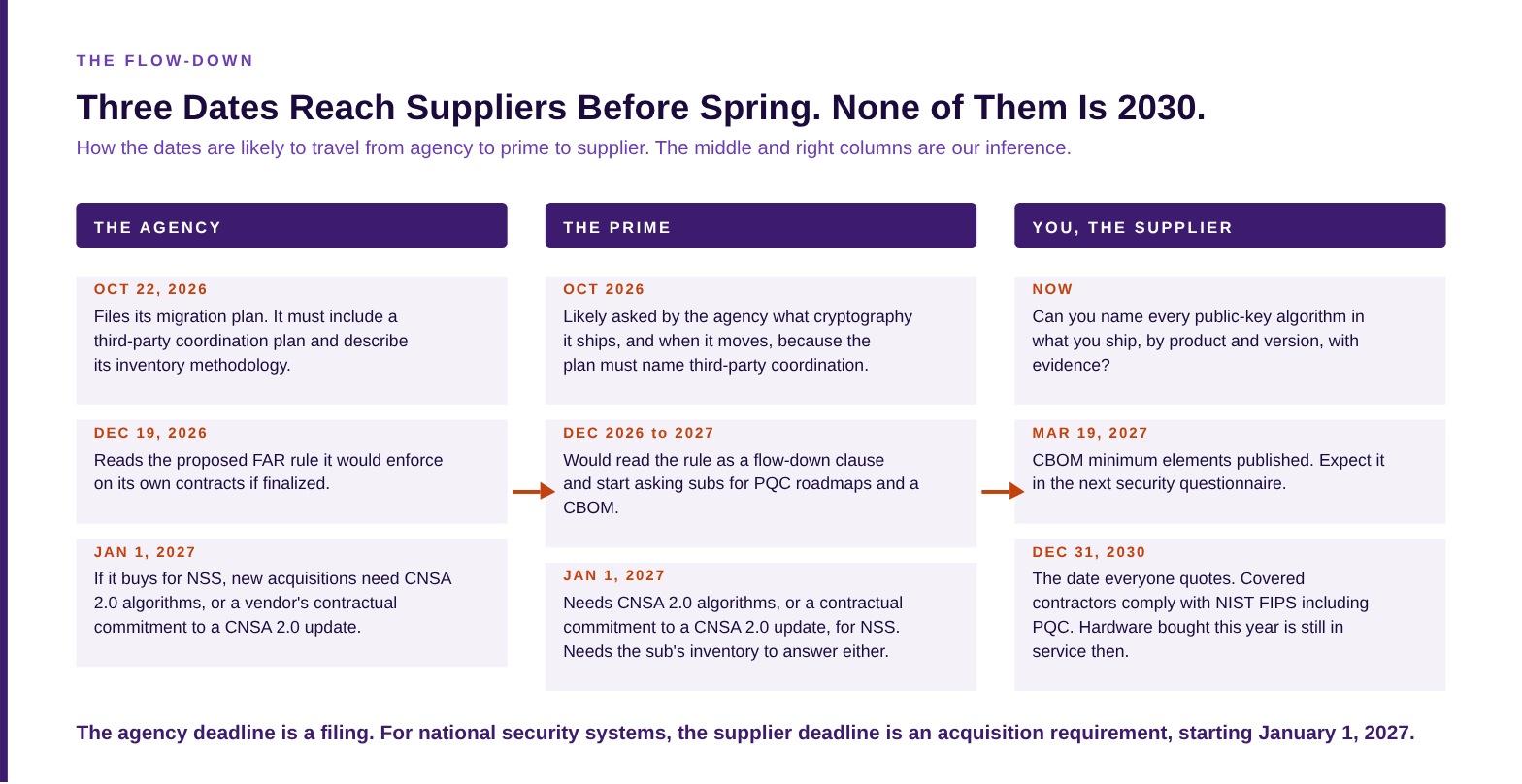
The dates that say 2030 and 2031 are real, and for the hardware in a program of record they are already inside the refresh cycle. But the dates that will change a supplier's quarter are the three above, and the latest of them falls on March 19, 2027.
For a bank or a hospital with no federal contract, the dates arrive sideways. In our reading, NIST's deprecation schedule, now final, becomes the horizon for every validation program and framework that cites FIPS, and the EU's 2030 milestone for high-risk use cases will be read by national regulators as covering the sectors they already supervise [5][6]. The federal supplier gets a questionnaire in 2027. The regulated enterprise gets an examiner's question a year or two later, and the answer is the same inventory.
Why 2030 Is a Decision This Year
The usual objection is that no cryptographically relevant quantum computer exists, which is true. The Global Risk Institute's 2025 survey of 26 experts puts the chance of one within ten years at 28 to 49 percent, and within fifteen years at 51 to 70 percent [8]. In March, Google Quantum AI published estimates that breaking a 256-bit elliptic-curve key would take fewer than 1,200 logical qubits and fewer than 500,000 physical qubits, running for minutes [9]. Google has set 2029 for its own migration [10]. Cloudflare set the same year for itself. On April 7, 2026, it said it now targets 2029 "to be fully post-quantum (PQ) secure including, crucially, post-quantum authentication" [11].
Those are forecasts and engineering targets, not events, and we treat them as such. The arithmetic that turns them into a decision is older than any of them. Add how long the data must stay secret to how long the migration will take. If the sum crosses the earliest credible arrival date, the system is already exposed, because an adversary who records the traffic now only needs the machine to arrive before the secret expires.
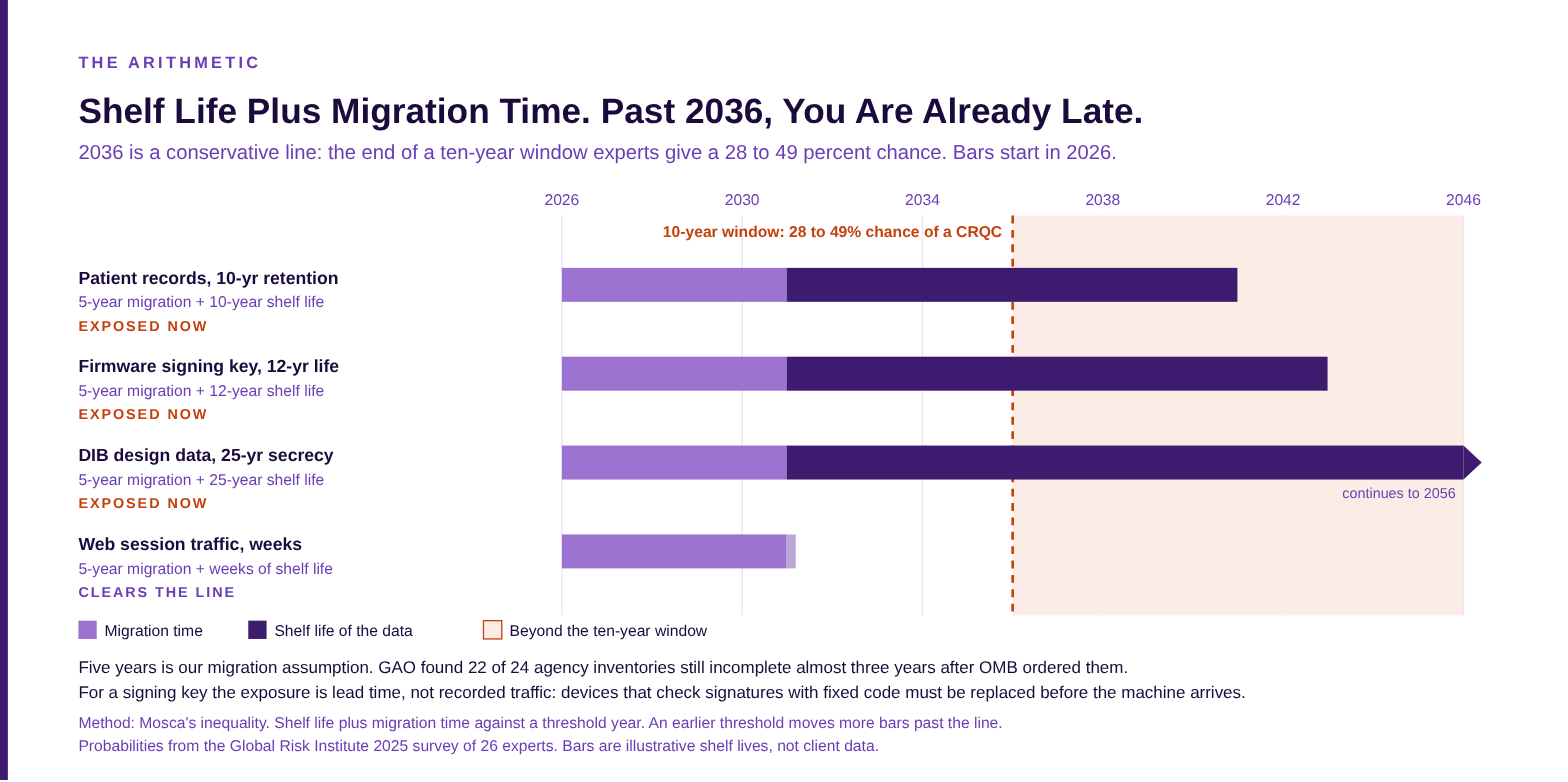
Five years is an optimistic migration estimate. GAO's audit found the largest agencies nearly three years into the inventory step with 22 of 24 still incomplete [7]. On that arithmetic, patient records, firmware signing keys and defense design data are all past the line today, and no 2030 deadline moves them back.
Documented fact. Agency PQC migration plans were due to OMB and ONCD by October 22, 2026, under M-26-15 [2]. EO 14412 sets December 31, 2030 for PQC key establishment and December 31, 2031 for PQC signatures on high-value assets and high impact systems, a proposed FAR rule within 180 days with contractor compliance by December 31, 2030, and CBOM minimum-elements guidance within 270 days [3]. CNSA 2.0 algorithms are required in all new NSS acquisitions from January 1, 2027, equipment that cannot support them phased out by December 31, 2030 unless an exception is granted, and CNSA 2.0 algorithms are mandated for use by December 31, 2031, unless otherwise noted [4]. NIST IR 8547, final as of October 27, 2026, deprecates quantum-vulnerable public-key cryptography after 2030 and disallows its use under NIST standards and guidelines after 2035 [5].
Reasonable inference. Because the FAR rule, the CNSA 2.0 acquisition cutoff and the CBOM guidance all land between December 2026 and March 2027, supplier questionnaires are likely to carry post-quantum algorithm and CBOM questions in 2027 regardless of when the compliance dates fall.
Structural risk analysis. The federal calendar is built on inventories. GAO found most of them incomplete and none of the sampled ones fully substantiated. If that holds, the 2030 and 2031 dates are likely to be met the way the October 22 plans were due to be, with filings that describe a migration the underlying data cannot yet support.
What We Are Not Saying
We are not predicting a CRQC date. The survey ranges are the experts' and the 2029 figure is Google's engineering target for its own systems, not a forecast [8][10].
The EU dates are not law. The roadmap is coordination among member states. A proposal to write a post-quantum policy requirement into the NIS2 directive exists, and it has not passed [1][6].
IR 8547 is NIST guidance, not law. It became final on October 27, 2026. It sets what NIST standards and guidelines will accept, and it does not by itself bind a private company [5].
We cite Google's and Cloudflare's 2029 dates as the migration targets those companies set for their own systems. We do not present either as a date for a working attack.
Where to Start
Two of the thirteen dates ask for things that exist today.
The first is the inventory, which every other date depends on. A QScout assessment produces the artifact the October 22 plans were supposed to rest on: a prioritized inventory of systems with vulnerable cryptography, across a governed 74-module catalog, delivered where approved as a cryptographic bill of materials in CycloneDX 1.7 [12]. When the CBOM minimum elements are published, due March 19, 2027, that is a format a questionnaire can ask for by name.
The second is the data that is already past the line in the arithmetic above, on systems that cannot be re-engineered before 2030. QShield by Qtonic Quantum Corp. is software only, with no hardware changes: post-quantum protection for the connections between enrolled Linux hosts, meant to address harvest-now-decrypt-later exposure for traffic routed through its protected path. It does not recover data recorded before protection began [13]. The cryptographic profile is locked at ML-KEM-1024 key establishment, ML-DSA-87 signatures and AES-256-GCM with no classical fallback, which are among the CNSA 2.0 algorithms [13]. The evidence is company-published, not independently verified, and hashed: a completed 72-hour run between two hosts with zero failures [13]. Separately, a signed historical record lists all 50 locations from September 26 to 28 [13]. The qualifying long-duration soak has not started, and its status is published with the evidence [13]. It is delivered through paid, operator-led engagements on Linux hosts the customer already runs [13].
Both are governed engagements rather than downloads. An analyst confirms the requester and the scope before any work begins [12][13].
Devil's Advocate: A Vendor Publishes a Deadline List and Finds Two of Its Products at the End of It
That is the shape of this piece, and the reader should price it in. The deadline map is public information arranged well, and the two products that close the piece are ours.
Three concessions. Most private companies have no legal post-quantum deadline, and nothing in the thirteen dates changes that directly. QShield by Qtonic Quantum Corp. protects the connections between enrolled Linux hosts, and it does not modify a radio, a crypto card or an embedded endpoint that cannot run it, so it is a bridge for part of an estate, not a migration. And using CNSA 2.0 algorithms is not the same as a claim of compliance under CNSA 2.0, which depends on validation status we do not hold and say so below.
What survives is the calendar. Six binding dates, two proposed rules and one final NIST report are set by governments, not by us, and the three that reach a supplier land between December and March. A company that cannot name the public-key algorithms in what it ships should expect to be asked in 2027 by someone who has to file an answer. That question does not need our product to be true. It needs a date, and the dates are now written down.
This material is for informational purposes only and does not constitute legal, regulatory, compliance, or professional advice, and it does not establish any professional relationship. Dates and requirements are summarized from the public instruments cited and may be amended. Day counts from signing dates to rule deadlines are our arithmetic. QShield by Qtonic Quantum Corp. is not represented as FIPS 140-3 validated or as holding Government authorization. Results described are those of the specific runs and records cited, within their stated scopes and dates. References to Technology.org, OMB, ONCD, NSA, NIST, CISA, GAO, the European Commission, Google, the Global Risk Institute and other third parties are based on publicly available information and are used for analysis and commentary. They do not imply partnership, endorsement, or affiliation. Product capabilities are described as of the date of publication and apply within the authorized scope of an engagement.
[1] Alius Noreika, "Post-Quantum Cryptography Deadlines: What Is Due, and When," Technology.org, October 15, 2026. Source for the deadline map we checked, its reading of EO 14412 Section 4(b) scope, its account of the EU roadmap and the January 2026 NIS2 amendment proposal, and its closing assessment of the October 22 filings. technology.org
[2] Office of Management and Budget, Memorandum M-26-15, "Execution of the Migration to Post-Quantum Cryptography," June 24, 2026. Plans due to OMB and ONCD no later than 120 days from the memorandum, which falls on October 22, 2026, with required contents including a third-party coordination plan, a system prioritization strategy with risk-based justification, and the methodologies and automated tools used for the cryptographic inventory. whitehouse.gov
[3] Executive Order 14412, "Securing the Nation Against Advanced Cryptographic Attacks," signed June 22, 2026, 91 FR 38483. Section 4(b): OMB guidance within 90 days directing agencies to transition all HVAs and high impact systems to PQC key establishment by December 31, 2030 and PQC digital signatures by December 31, 2031. Section 5(d): within 270 days, CISA in coordination with NIST releases guidance on the minimum elements for a cryptographic bill of materials. Section 6(c): within 180 days, the FAR Council publishes a proposed rule requiring covered contractors to comply with NIST's FIPS, including PQC-compliant algorithms, by December 31, 2030. Section 6(d): within 270 days, a proposed rule on contractor vulnerability disclosure policies incorporating reports of cryptographic vulnerabilities. The conversion of 180 and 270 days to December 19, 2026 and March 19, 2027 is our arithmetic. federalregister.gov
[4] National Security Agency, "The Commercial National Security Algorithm Suite 2.0 and Quantum Computing FAQ," Version 2.2, October 2026 (U/OO/6072712-26, PP-26-3194). Source for the statement that by January 1, 2027, CNSA 2.0 algorithms will be required in all new acquisitions for NSS, phase-out of equipment and services that cannot support CNSA 2.0 by December 31, 2030 unless otherwise granted an exception, CNSA 2.0 algorithms are mandated for use by December 31, 2031, unless otherwise noted, the intent that all NSS be quantum-resistant well ahead of the 2035 goal in NSM-10, and the statement that larger RSA or elliptic-curve key sizes do not address the threat. media.defense.gov
[5] NIST IR 8547, "Transition to Post-Quantum Cryptography Standards," final, October 2026, posted October 27, 2026, superseding the initial public draft of November 12, 2024. NIST will deprecate quantum-vulnerable public-key cryptography after 2030 and disallow its use under NIST standards and guidelines after 2035. Table 2 lists ECDSA, EdDSA and RSA signatures, and Table 4 lists the quantum-vulnerable key-establishment schemes, as deprecated after 2030 and disallowed after 2035. The report states that this window does not alter the earlier deadlines for high value assets, high impact systems and other high-sensitivity federal systems under EO 14412 and OMB M-26-15. nist.gov
[6] EU Member States with the European Commission, "A Coordinated Implementation Roadmap for the Transition to Post-Quantum Cryptography," published June 23, 2025. Milestones from the roadmap document: by 31 December 2026, national PQC roadmaps in place and planning for high- and medium-risk use cases underway. By 31 December 2030, the PQC transition for high-risk use cases completed and quantum-safe software and firmware upgrades enabled by default. By 31 December 2035, the transition for low-risk use cases completed as much as feasible. The roadmap is coordination among member states, not EU law. digital-strategy.ec.europa.eu, roadmap document at ec.europa.eu
[7] U.S. Government Accountability Office, "Quantum Computing: Federal Actions Needed to Prepare for Emerging Cyber Threat," GAO-27-108740, October 6, 2026, reissued with revisions October 14, 2026, public version of GAO-25-107392SU of September 11, 2025. One of 24 agencies fully addressed the prioritized inventory activities, one developed no inventory, 22 partially addressed it, none of the six sampled agencies fully substantiated the algorithms in their inventories, several inventories incorrectly listed symmetric algorithms as quantum-vulnerable, 89 recommendations to 23 agencies, audit period February 2024 to September 2025. gao.gov
[8] Global Risk Institute, "Quantum Threat Timeline Report 2025," Michele Mosca and Marco Piani, published March 9, 2026. Survey of 26 experts: a CRQC quite possible, 28 to 49 percent, within ten years, and likely, 51 to 70 percent, within fifteen. globalriskinstitute.org
[9] Ryan Babbush and Hartmut Neven, "Safeguarding cryptocurrency by disclosing quantum vulnerabilities responsibly," Google Research blog, March 31, 2026, with the whitepaper at arXiv 2603.28846. Two circuits for the 256-bit elliptic-curve discrete logarithm, one using fewer than 1,200 logical qubits and 90 million Toffoli gates, the other fewer than 1,450 logical qubits and 70 million, runnable on a superconducting machine with fewer than 500,000 physical qubits in a few minutes under assumptions consistent with Google's flagship processors. The post refers to Google's 2029 migration timeline. research.google
[10] Heather Adkins and Sophie Schmieg, "Quantum frontiers may be closer than they appear," Google, March 25, 2026. blog.google
[11] Bas Westerbaan, "Cloudflare targets 2029 for full post-quantum security," Cloudflare blog, April 7, 2026. blog.cloudflare.com
[12] QScout is the assessment. Reassessment is available through QScout Pulse. No self-serve public scan runs from the website. The public page captures authorization context and routes the request to Qtonic Quantum Corp, and an analyst confirms the requester and scope before assessment work is fulfilled. Outputs include an approved-scope exposure inventory, control and compliance mapping, a remediation path by ownership lane, and CBOM and governed artifacts where approved. Sources: qtonicquantum.com/qscout and qtonicquantum.com/platform, accessed November 2026.
[13] QShield by Qtonic Quantum Corp. evidence, published at qtonicquantum.com/proof-center/qshield-endurance and qtonicquantum.com/qshield, accessed November 2026. Completed run 2026-09-13 04:28:48Z to 2026-09-16 04:29:04Z between two Linux hosts in separate AWS Oregon availability zones, 259,219 seconds, 4,107 checks, zero failures, with build and log SHA-256 hashes published. Signed record of 482 observations over 50 hours from 26 to 28 September 2026, each listing all 50 locations, latest signed 2026-09-28 18:23 UTC, with the allowed-signers key published. Locked suite of ML-KEM-1024, ML-DSA-87 and AES-256-GCM with no classical fallback. The qualifying long-duration soak is published as not started. Company-published, not independently verified. QShield is not represented as FIPS 140-3 validated or as holding Government authorization. Delivery is through paid, operator-led engagements on Linux hosts the customer already runs. qtonicquantum.com
Can you name every public-key algorithm in what you ship, with evidence, before someone with an October 22 filing asks you to?
Request an assessment, or a QShield by Qtonic Quantum Corp. engagement for the systems that cannot wait for 2030. An analyst confirms authorization and scope before anything runs. qtonicquantum.com/qscout | qtonicquantum.com/qshield
Find. Prove. Fix.
Post-Quantum Ready, Continuously™
Qtonic Quantum Corp is a quantum risk and vulnerability intelligence firm. Its platforms and advisory services help enterprises and government agencies reach post-quantum readiness and sustain it continuously, as standards, threats, and infrastructure evolve. Miami, Florida. qtonicquantum.com